Certified OSHA Training
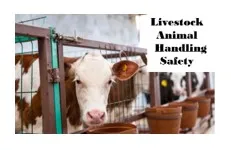
Livestock and Animal handling Safety
- OSHA-Authorized
- DOL-Aligned
$
$75.00$
What You’ll Learn?
Updated:
Livestock and Animal handling Safety
\
What You’ll Learn?
Course Details
Livestock and Animal Handling Safety is a self-paced online course that teaches farm and ranch workers, livestock handlers, and animal care staff how to work safely around cattle, swine, sheep, goats, and equines. Agriculture safety refers to practices, training, and policies designed to protect workers from the many hazards found in farming, ranching, and related industries. These include machinery, chemicals, extreme weather, animal handling, and confined spaces. Agriculture safety aims to reduce injuries, illnesses, and fatalities in one of the most hazardous work sectors in the U.S. Building on those principles, this training focuses on animal behavior, the flight zone and point of balance, and low-stress handling techniques that reduce agitation and injury risk for both handlers and animals. It also covers facility and equipment safety, proper personal protective equipment (PPE), and basic zoonotic disease and biosecurity awareness.
Because course access is fully online and asynchronous, participants can complete the roughly 3.5 hours of instruction at their own pace within the allotted access period. Many small farms are exempt from certain federal OSHA agricultural standards, so this course is built around industry best practices, animal welfare principles, and practical injury-prevention skills rather than a claim of regulatory mandate. Learners who finish all activities and pass the required assessment earn a certificate of completion and 0.35 IACET CEUs for their professional records. Enroll today to build safer, more confident livestock and animal handling habits for your operation.
Course Syllabus
Course Description
Pre-Course Information Sheet
Course: Livestock and Animal Handling Safety (Online)
Course Overview
This course provides foundational and applied instruction in safe livestock and animal handling practices across agricultural and animal care environments. Learners will explore animal behavior, low-stress handling techniques, facility safety design, and risk mitigation strategies to reduce injuries to both handlers and animals.
The course emphasizes practical safety skills applicable to cattle, swine, sheep, goats, equines, and mixed livestock operations. Instruction supports compliance with industry’s best practices, animal welfare principles, and occupational safety standards.
Delivery Method
Online / LMS-Based Asynchronous Learning
Participants may complete the course at their own pace within the allotted course access period.
Course Duration
3.5 Contact Hours
IACET CEUs Awarded
0.35 CEU
Technical Requirements
Participants must have:
- Reliable internet access
- Current web browser (Chrome, Edge, Firefox, or Safari)
- Audio capability for course videos and PowerPoint
- Ability to view PDF documents
- Access to the TTI Learning Management System (LMS)
Recommendation:
- Desktop or laptop computer for optimal learning experience
Criteria for Earning IACET
To receive 0.35 IACET CEU, participants must:
- Complete all required course modules
- Complete all learning activities
- Successfully complete required assessments
- Achieving a minimum passing score of 80% on course assessments
- Complete the course evaluation
Learner Support
Technical assistance is available for LMS access and navigation issues.
For support, contact:
Phone: (817) 769-6275
Email: [email protected]
Accessibility Statement
TTI is committed to providing an accessible learning environment. Course materials include accessibility features such as:
- Accessible digital content
- Adjustable screen viewing options where available
Learners requiring accommodation should contact TTI prior to beginning the course.
Important Completion Information
Participants are encouraged to complete the course within the assigned enrollment period. Progress is automatically tracked within the LMS.
Failure to complete all required activities and assessments will result in no CEU award being issued.
Acknowledgment
By beginning this course, participants acknowledge that they have reviewed and understand the course requirements, learning outcomes, participation expectations, and CEU award criteria.
What Will I Learn?
Upon successful completion of this course, participants will be able to:
- Identify common hazards associated with livestock and animal handling environments
- Explain basic animal behavior principles (flight zone, point of balance, herd instincts)
- Demonstrate safe approaches for moving, restraining, and working around livestock
- Apply low-stress handling techniques to reduce animal agitation and injury risk
- Recognize facility design features that improve handler safety and animal flow
- Use appropriate personal protective equipment (PPE) for animal handling tasks
- Respond appropriately to animal-related incidents and emergencies
Target Audience
This course is intended for:
- Farm and ranch workers
- Livestock handlers and stockyard personnel
- Veterinary assistants and animal care staff
- Agricultural industry workers
- First responders supporting animal-related incidents
- Students entering agriculture or animal science fields
Total Course Duration
3 hours, 30 minutes
Materials Included
Participants will have access to:
- Livestock and Animal Handling Safety Modules
- Final Assessment
- Course Evaluation
Requirements / Instructions
There are no formal prerequisites for this course.
Participants should:
- Have basic reading and comprehension skills
- Be physically able to participate in practical handling activities (if applicable)
- Be capable of following safety instructions in agricultural environments
Curriculum
2 modules · 3 hours
Livestock and Animal Handling Safety
Livestock and animal handling training focuses on low-stress, humane techniques designed to improve animal welfare, handler safety, and operational efficiency. Programs teach understanding of animal behavior, flight zones, and herd instincts to safely move cattle, horses, and other species. Training is available through university extensions, specialized safety services, and professional organizations like NACA for both ranching and emergency response.
- Livestock and Animal Handling SafetyLesson
- Livestock and Animal Handling Safety FinalQuiz
Course Evaluation
\
- Course Review & CompletionLesson
Certificate of Completion
Meet Your Instructor
Lead HSE Instructor

The Training Institute is a team of seasoned field experts with decades of hands-on experience across electrical safety, OSHA compliance, confined-space training, and hazardous-materials response. Our instructors combine practical jobsite expertise with proven adult-learning methodology to deliver training that meets — and exceeds — federal and industry standards.
Student Review
(
0 Review)
Similar Courses
by
The Training Institute
by
The Training Institute
Ready to get certified?
Enroll in Livestock and Animal handling Safety
Volume pricing for 5+ seats. Dedicated compliance support and audit-ready records.
Sign Up for Newsletter
Quick Links
Visit Us
1509 S. Dobson Street
Burleson, TX 76028
© 2026 The Training Institute. All rights reserved.
Course Materials
Preview the materials included with this course. Enrolled students can download all files.
- Livestock and Animal Handling SafetySign in & enroll