Certified OSHA Training
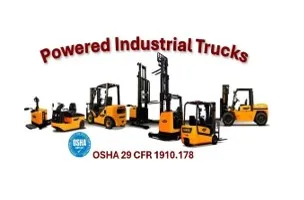
Powered Industrial Trucks
- OSHA-Authorized
- DOL-Aligned

$
$75.00$
What You’ll Learn?
Updated:
Powered Industrial Trucks
\
What You’ll Learn?
The Powered Industrial Trucks course is a self-paced, OSHA-aligned online training program from The Training Institute. Powered Industrial Trucks delivers in-depth instruction, a final assessment, and a printable certificate of completion the moment you pass.
About the Powered Industrial Trucks Course
Enrollment includes every lesson module, narrated video, a downloadable participant workbook keyed to 29 CFR 1910.178 and ANSI/ITSDF B56.1, a pre-operation inspection checklist specific to each PIT class (I electric rider, II narrow-aisle, III hand/rider, IV IC cushion tire, V IC pneumatic tire, VI tractor, VII rough-terrain), a stability-triangle illustration and load-capacity-data-plate interpretation worksheet, a battery-charging-room safety checklist aligned to NFPA 505 and 29 CFR 1910.178(g), a propane-cylinder exchange procedure for IC trucks, a ramp-and-grade operation safety guide, an intersection and pedestrian-interaction traffic plan template, a refueling-safety procedure for IC trucks, a maintenance log keyed to 1910.178(q), an operator written-certification form aligned to 1910.178(l)(6), an operator performance-evaluation form for the employer-conducted (l)(4) evaluation, and scenario-based knowledge-check quizzes at the end of each module. Students also receive a regulatory quick-reference card, a fuel-source hazard matrix for internal-combustion versus electric, and a printable certificate of completion issued immediately after passing the final exam.The enrollment package adds a refresher-training trigger decision tree mapping 1910.178(l)(4)(ii), a loading-dock fall-protection checklist bridging 1910.28, an order-picker harness-and-lanyard inspection log, and an OSHA-preferred daily pre-operation inspection card that operators can mount to the truck.The training also documents the 29 CFR 1910.178(m)(14) raised-load-under-forks prohibition, the (m)(12) seatbelt rule where seatbelts are installed, the (n)(15) traveling-with-forks-fully-lowered rule on ramps and grades, and the (n)(5) blind-intersection horn and mirror requirements applicable in all warehouse and distribution-center operations.
What You Will Learn in Powered Industrial Trucks
This Powered Industrial Trucks course delivers the operator training required by 29 CFR 1910.178(l) for every employee who operates a forklift, reach truck, order picker, sit-down counterbalance truck, stand-up rider truck, pallet jack, tow tractor, or other powered industrial truck. Learners build competency in the full scope of the OSHA PIT standard 29 CFR 1910.178: the eleven truck classifications (Class I electric motor rider, Class II electric motor narrow-aisle, Class III electric motor hand or hand/rider, Class IV internal combustion engine cushion tire, Class V internal combustion engine pneumatic tire, Class VI electric and internal combustion tractor, Class VII rough-terrain forklift), battery-charging and propane-cylinder exchange safety, pre-operation inspection requirements, load-capacity interpretation from the data plate, stability triangle and the combined center of gravity, traveling with loads (raised versus lowered), grade and ramp operation, pedestrian-interaction controls, horn use and intersection rules, parking and lowering-of-forks requirements, refueling safety, and the 29 CFR 1910.178(q) maintenance obligations. The curriculum cross-references ANSI/ITSDF B56.1 for trucks and ASME B30.5 for mobile cranes at load-handling attachment interfaces, NFPA 505 for fire safety in battery rooms, and the OSHA 29 CFR 1910.132(f) PPE training verification obligation. Each module includes scenario-based knowledge checks and concludes with a written assessment. The course satisfies the formal-instruction element of 29 CFR 1910.178(l)(2)(ii); the employer must still conduct and document site-specific practical training and operator evaluation under (l)(2)(iii) and (l)(4).Additional related content covers OSHA enforcement data showing forklift incidents in the top causes of fatal occupational injury in general industry, the OSHA 1910.178(l)(4) triennial operator evaluation requirement, the refresher-training trigger list at (l)(4)(ii) following an accident, near-miss, or observation of unsafe operation, and the interplay with 29 CFR 1910.176 materials-handling and storage rules, 1910.23 fixed ladder rules on loading docks, and 1910.28 walking-working-surface fall protection for order-picker operators.The course also discusses telehandler operation under ANSI A92.6, aerial-lift safety under ANSI A92 series and 29 CFR 1910.67, loading-dock leveler and dock-plate integrity, trailer-wheel-chock and truck-restraint procedures, pallet integrity and stacking limits, and the 29 CFR 1910.176(b) safe-clearance requirement for powered industrial truck aisles and passageways.The training additionally walks through the 29 CFR 1910.178(p) operation-of-trucks general rules, the (m) safeguards for operators, the (n) traveling rules for grades and blind intersections, the (o) loading procedures for stable stacking and cross-tiering, and the (q) maintenance obligations including removal-from-service upon identification of any condition adversely affecting the safety of the truck.
Who Should Take Powered Industrial Trucks
The course is required for every employee assigned to operate a powered industrial truck and is built for warehouse operators, distribution-center staff, 3PL and 4PL workers, manufacturing-plant material handlers, big-box retail receiving teams, food-processing plant forklift drivers, cold-storage warehouse operators, lumber-yard and building-material drivers, dock workers, longshore workers where 29 CFR 1917 overlaps, construction material handlers, maintenance electricians and mechanics who occasionally operate PITs, and shift supervisors responsible for operator oversight. It is equally appropriate for safety directors, EHS managers, warehouse operations managers, fleet coordinators, third-party staffing agency safety specialists assigning temporary PIT operators, insurance loss-control consultants evaluating forklift risk, industrial hygienists studying carbon-monoxide exposure from internal-combustion PITs, and OSHA authorized outreach trainers delivering 10-hour and 30-hour general-industry curricula. Employers use the training to satisfy the 29 CFR 1910.178(l)(2)(ii) formal-instruction requirement, and the certificate provides documentation for the (l)(6) written certification obligation. Train-the-trainer candidates preparing to deliver the (l)(2)(iii) practical portion and (l)(4) operator evaluation also benefit from the course as reference material.The course also supports third-party logistics safety directors auditing contract warehouse operations, retail distribution-center general managers coordinating peak-season temp-worker onboarding, and cold-chain pharmaceutical logistics teams handling temperature-controlled loads.Industrial-staffing safety specialists, temp-agency onboarding teams, and equipment-rental company customer-education staff who onboard short-term PIT operators also rely on the course structure.
Course Details
Level: Intermediate. Price: $75.00. Browse our full course catalog for more options.
Your Instructor
The Training Institute — Training Institute Instructor Team
The Training Institute is a team of seasoned field experts with decades of hands-on experience across electrical safety, OSHA compliance, confined-space training, and hazardous-materials response. Our instructors combine practical jobsite expertise with proven adult-learning methodology to deliver training that meets — and exceeds — federal and industry standards.
Certificate of Completion
Upon successful completion of this training program, participants receive an official certificate of completion from The Training Institute.
Curriculum
- Powered Industrial Trucks
- Course Evaluation
- Course Review & Completion
Standards & Compliance for Powered Industrial Trucks
Powered Industrial Trucks aligns with current OSHA outreach training program guidance and is reviewed regularly against the latest federal standards. Learners completing Powered Industrial Trucks receive a printable certificate they can submit to employers as documented evidence of safety training, and may purchase additional Training Institute courses to satisfy related annual requirements.
What Will I Learn?
This Powered Industrial Trucks course delivers the operator training required by 29 CFR 1910.178(l) for every employee who operates a forklift, reach truck, order picker, sit-down counterbalance truck, stand-up rider truck, pallet jack, tow tractor, or other powered industrial truck. Learners build competency in the full scope of the OSHA PIT standard 29 CFR 1910.178: the eleven truck classifications (Class I electric motor rider, Class II electric motor narrow-aisle, Class III electric motor hand or hand/rider, Class IV internal combustion engine cushion tire, Class V internal combustion engine pneumatic tire, Class VI electric and internal combustion tractor, Class VII rough-terrain forklift), battery-charging and propane-cylinder exchange safety, pre-operation inspection requirements, load-capacity interpretation from the data plate, stability triangle and the combined center of gravity, traveling with loads (raised versus lowered), grade and ramp operation, pedestrian-interaction controls, horn use and intersection rules, parking and lowering-of-forks requirements, refueling safety, and the 29 CFR 1910.178(q) maintenance obligations. The curriculum cross-references ANSI/ITSDF B56.1 for trucks and ASME B30.5 for mobile cranes at load-handling attachment interfaces, NFPA 505 for fire safety in battery rooms, and the OSHA 29 CFR 1910.132(f) PPE training verification obligation. Each module includes scenario-based knowledge checks and concludes with a written assessment. The course satisfies the formal-instruction element of 29 CFR 1910.178(l)(2)(ii); the employer must still conduct and document site-specific practical training and operator evaluation under (l)(2)(iii) and (l)(4).Additional related content covers OSHA enforcement data showing forklift incidents in the top causes of fatal occupational injury in general industry, the OSHA 1910.178(l)(4) triennial operator evaluation requirement, the refresher-training trigger list at (l)(4)(ii) following an accident, near-miss, or observation of unsafe operation, and the interplay with 29 CFR 1910.176 materials-handling and storage rules, 1910.23 fixed ladder rules on loading docks, and 1910.28 walking-working-surface fall protection for order-picker operators.The course also discusses telehandler operation under ANSI A92.6, aerial-lift safety under ANSI A92 series and 29 CFR 1910.67, loading-dock leveler and dock-plate integrity, trailer-wheel-chock and truck-restraint procedures, pallet integrity and stacking limits, and the 29 CFR 1910.176(b) safe-clearance requirement for powered industrial truck aisles and passageways.The training additionally walks through the 29 CFR 1910.178(p) operation-of-trucks general rules, the (m) safeguards for operators, the (n) traveling rules for grades and blind intersections, the (o) loading procedures for stable stacking and cross-tiering, and the (q) maintenance obligations including removal-from-service upon identification of any condition adversely affecting the safety of the truck.
Target Audience
The course is required for every employee assigned to operate a powered industrial truck and is built for warehouse operators, distribution-center staff, 3PL and 4PL workers, manufacturing-plant material handlers, big-box retail receiving teams, food-processing plant forklift drivers, cold-storage warehouse operators, lumber-yard and building-material drivers, dock workers, longshore workers where 29 CFR 1917 overlaps, construction material handlers, maintenance electricians and mechanics who occasionally operate PITs, and shift supervisors responsible for operator oversight. It is equally appropriate for safety directors, EHS managers, warehouse operations managers, fleet coordinators, third-party staffing agency safety specialists assigning temporary PIT operators, insurance loss-control consultants evaluating forklift risk, industrial hygienists studying carbon-monoxide exposure from internal-combustion PITs, and OSHA authorized outreach trainers delivering 10-hour and 30-hour general-industry curricula. Employers use the training to satisfy the 29 CFR 1910.178(l)(2)(ii) formal-instruction requirement, and the certificate provides documentation for the (l)(6) written certification obligation. Train-the-trainer candidates preparing to deliver the (l)(2)(iii) practical portion and (l)(4) operator evaluation also benefit from the course as reference material.The course also supports third-party logistics safety directors auditing contract warehouse operations, retail distribution-center general managers coordinating peak-season temp-worker onboarding, and cold-chain pharmaceutical logistics teams handling temperature-controlled loads.Industrial-staffing safety specialists, temp-agency onboarding teams, and equipment-rental company customer-education staff who onboard short-term PIT operators also rely on the course structure.
Materials Included
Enrollment includes every lesson module, narrated video, a downloadable participant workbook keyed to 29 CFR 1910.178 and ANSI/ITSDF B56.1, a pre-operation inspection checklist specific to each PIT class (I electric rider, II narrow-aisle, III hand/rider, IV IC cushion tire, V IC pneumatic tire, VI tractor, VII rough-terrain), a stability-triangle illustration and load-capacity-data-plate interpretation worksheet, a battery-charging-room safety checklist aligned to NFPA 505 and 29 CFR 1910.178(g), a propane-cylinder exchange procedure for IC trucks, a ramp-and-grade operation safety guide, an intersection and pedestrian-interaction traffic plan template, a refueling-safety procedure for IC trucks, a maintenance log keyed to 1910.178(q), an operator written-certification form aligned to 1910.178(l)(6), an operator performance-evaluation form for the employer-conducted (l)(4) evaluation, and scenario-based knowledge-check quizzes at the end of each module. Students also receive a regulatory quick-reference card, a fuel-source hazard matrix for internal-combustion versus electric, and a printable certificate of completion issued immediately after passing the final exam.The enrollment package adds a refresher-training trigger decision tree mapping 1910.178(l)(4)(ii), a loading-dock fall-protection checklist bridging 1910.28, an order-picker harness-and-lanyard inspection log, and an OSHA-preferred daily pre-operation inspection card that operators can mount to the truck.The training also documents the 29 CFR 1910.178(m)(14) raised-load-under-forks prohibition, the (m)(12) seatbelt rule where seatbelts are installed, the (n)(15) traveling-with-forks-fully-lowered rule on ramps and grades, and the (n)(5) blind-intersection horn and mirror requirements applicable in all warehouse and distribution-center operations.
Curriculum
2 modules
Powered Industrial Trucks
- Powered Industrial TrucksLesson
- Powered Industrial TrucksQuiz
Course Evaluation
- Course Review & CompletionLesson
Certificate of Completion
Meet Your Instructor
Lead HSE Instructor

The Training Institute is a team of seasoned field experts with decades of hands-on experience across electrical safety, OSHA compliance, confined-space training, and hazardous-materials response. Our instructors combine practical jobsite expertise with proven adult-learning methodology to deliver training that meets — and exceeds — federal and industry standards.
Student Review
(
0 Review)
Similar Courses

by
The Training Institute
by
The Training Institute
by
The Training Institute
Ready to get certified?
Enroll in Powered Industrial Trucks
Volume pricing for 5+ seats. Dedicated compliance support and audit-ready records.