Certified OSHA Training

Substation Safety Training
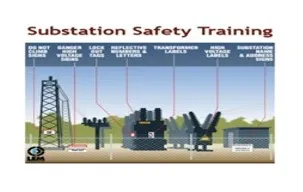
Substation Safety Training
$50Self-paced online training
Enroll now
  • Self-paced online
  • Certificate included
  • 1 learner
Buy Substation Safety Training

$

$50.00

$

The Substation Safety Training course is an online program built around OSHA 29 CFR 1910.269 (electric power generation, transmission, and distribution), 29 CFR 1926 Subpart V (construction), and NFPA 70E work practices applied to substation environments. Enrollees receive SCORM learning modules, a downloadable participant handbook, a job briefing template, an energized-work permit sample, minimum approach distance (MAD) quick-reference cards, grounding and equipotential-zone diagrams, and switching-order examples.

  • Interactive SCORM modules covering substation equipment identification, host/contract employer duties, job briefings, switching and tagging, grounding, MAD tables, and arc-flash considerations.
  • Minimum approach distance (MAD) job aid for voltages from 50 V through 800 kV with phase-to-ground and phase-to-phase tables.
  • Editable job briefing and energized-work permit template aligned with 1910.269(c) and NFPA 70E 110.3.
  • Equipotential-zone and bracket-grounding diagrams with reference impedance calculations.
  • Knowledge checks, final assessment, and a printable certificate of completion on passing.
  • Level

    All Levels

    Level

    Time to Complete

    0 hour 0 minute

    Lessons

    2 Lessons

    Language

    English

    Rating

    (

    1 Review

    )

    What You’ll Learn?

    Updated:

    May 4, 2026

    Substation Safety Training

    1 Student

    What You’ll Learn?

    Substations concentrate more stored electrical and mechanical energy than almost any other industrial environment, and the consequences of a single error (a missed ground, a misunderstood switching order, an encroached approach distance, or a dropped tool across a bus) are catastrophic. The Substation Safety Training course prepares qualified electrical workers and their supervisors to plan, authorize, execute, and document work inside energized and de-energized substations in full alignment with OSHA 29 CFR 1910.269 and NFPA 70E.

    Participants learn to identify substation equipment, including power transformers, oil and gas circuit breakers, SF6 gas-insulated switchgear, disconnect switches, air-break switches, capacitor banks, reactors, station service transformers, control houses, battery rooms, surge arresters, potential and current transformers, and relaying and SCADA systems. The course reviews host-employer and contract-employer information exchange under 1910.269(a)(3), the pre-job briefing required before each job and whenever conditions change, and the written energized-work permit process when de-energization is not feasible.

    Learners study minimum approach distances (MAD) for nominal voltages from 50 V through 800 kV, the factors that increase MAD (altitude, transient overvoltages, system impedance), and the controls that reduce exposure: cover-ups, insulating platforms, live-line tools, barehand technique, and temporary protective grounds. Grounding theory (single-point grounds, bracket grounds, equipotential zones, ground mats, and induced-voltage considerations on transmission lines paralleling energized circuits) is reinforced with worked examples and narrated diagrams.

    The course concludes with arc-flash considerations inside substations, selection of arc-rated PPE per NFPA 70E 130.7, rescue and emergency-response planning for high-voltage exposure and burns, and documentation expected during OSHA, regulatory, and owner audits. Utilities, industrial plant owners with on-site substations, renewable-energy developers, and contractor workforces gain a defensible training record that supports the qualified-worker designation under 1910.269(a)(2) and NFPA 70E 110.6.

    The Substation Safety Training course is a self-paced, OSHA-aligned online training program from The Training Institute. Substation Safety Training delivers in-depth instruction, a final assessment, and a printable certificate of completion the moment you pass.

    About the Substation Safety Training Course

    The Substation Safety Training course is an online program built around OSHA 29 CFR 1910.269 (electric power generation, transmission, and distribution), 29 CFR 1926 Subpart V (construction), and NFPA 70E work practices applied to substation environments. Enrollees receive SCORM learning modules, a downloadable participant handbook, a job briefing template, an energized-work permit sample, minimum approach distance (MAD) quick-reference cards, grounding and equipotential-zone diagrams, and switching-order examples.

    • Interactive SCORM modules covering substation equipment identification, host/contract employer duties, job briefings, switching and tagging, grounding, MAD tables, and arc-flash considerations.
    • Minimum approach distance (MAD) job aid for voltages from 50 V through 800 kV with phase-to-ground and phase-to-phase tables.
    • Editable job briefing and energized-work permit template aligned with 1910.269(c) and NFPA 70E 110.3.
    • Equipotential-zone and bracket-grounding diagrams with reference impedance calculations.
    • Knowledge checks, final assessment, and a printable certificate of completion on passing.

    What You Will Learn in Substation Safety Training

    Substations concentrate more stored electrical and mechanical energy than almost any other industrial environment, and the consequences of a single error (a missed ground, a misunderstood switching order, an encroached approach distance, or a dropped tool across a bus) are catastrophic. The Substation Safety Training course prepares qualified electrical workers and their supervisors to plan, authorize, execute, and document work inside energized and de-energized substations in full alignment with OSHA 29 CFR 1910.269 and NFPA 70E.

    Participants learn to identify substation equipment, including power transformers, oil and gas circuit breakers, SF6 gas-insulated switchgear, disconnect switches, air-break switches, capacitor banks, reactors, station service transformers, control houses, battery rooms, surge arresters, potential and current transformers, and relaying and SCADA systems. The course reviews host-employer and contract-employer information exchange under 1910.269(a)(3), the pre-job briefing required before each job and whenever conditions change, and the written energized-work permit process when de-energization is not feasible.

    Learners study minimum approach distances (MAD) for nominal voltages from 50 V through 800 kV, the factors that increase MAD (altitude, transient overvoltages, system impedance), and the controls that reduce exposure: cover-ups, insulating platforms, live-line tools, barehand technique, and temporary protective grounds. Grounding theory (single-point grounds, bracket grounds, equipotential zones, ground mats, and induced-voltage considerations on transmission lines paralleling energized circuits) is reinforced with worked examples and narrated diagrams.

    The course concludes with arc-flash considerations inside substations, selection of arc-rated PPE per NFPA 70E 130.7, rescue and emergency-response planning for high-voltage exposure and burns, and documentation expected during OSHA, regulatory, and owner audits. Utilities, industrial plant owners with on-site substations, renewable-energy developers, and contractor workforces gain a defensible training record that supports the qualified-worker designation under 1910.269(a)(2) and NFPA 70E 110.6.

    Who Should Take Substation Safety Training

    This course is designed for qualified electrical workers, substation technicians, relay technicians, protection and control specialists, apparatus crews, switchmen, line foremen, substation construction crews, commissioning engineers, and the supervisors who authorize their work. Utility employees at investor-owned utilities, public power agencies, municipal and cooperative utilities, and transmission operators will find the content directly applicable to daily switching, maintenance, and capital-project activity.

    Industrial plant owners with on-site distribution and primary-voltage substations (refineries, petrochemical plants, steel mills, pulp and paper facilities, mining operations, data centers, and large manufacturing campuses) benefit when their electrical workforce supports the utility interface. Renewable-energy owners and contractors building and maintaining wind, solar, and battery-storage collector substations rely on this training to satisfy owner and interconnection-agreement requirements.

    EHS managers, electrical engineers, project managers, commissioning agents, and safety coordinators use the same material to audit contractors, approve energized-work permits, and maintain the host-employer information required by 1910.269(a)(3). Apprentice lineworkers and substation technicians in the later years of their program gain the structured classroom foundation before they work energized or near energized equipment under a qualified mentor.

    Prerequisites

    Learners should hold, or be working toward, a qualified-worker designation under 1910.269(a)(2) and have a working understanding of basic electrical theory, including Ohm's Law, three-phase power, per-unit and symmetrical-component concepts at a conceptual level, and the difference between phase-to-ground and phase-to-phase voltage. Familiarity with reading one-line diagrams, relay settings summaries, and switching orders is helpful but not required; all concepts are reinforced with diagrams and worked examples inside the course.

    No specific prerequisite credential is required to enroll. Employers designating learners as qualified workers after completion must also provide documented on-the-job training with an experienced qualified worker, equipment-specific competency verification, current first-aid and CPR certification, and resuscitation training where exposure to more than 50 volts exists. A modern browser, reliable internet connection, and a device with audio are the only technical requirements for completing the online modules and the final assessment.

    Course Details

    Price: $50.00. Browse our full course catalog for more options.

    Your Instructor

    The Training Institute — Training Institute Instructor Team

    The Training Institute is a team of seasoned field experts with decades of hands-on experience across electrical safety, OSHA compliance, confined-space training, and hazardous-materials response. Our instructors combine practical jobsite expertise with proven adult-learning methodology to deliver training that meets — and exceeds — federal and industry standards.

    Certificate of Completion

    Upon successful completion of this training program, participants receive an official certificate of completion from The Training Institute.

    Curriculum

    • Substation Safety Training
      • Substation Safety Training
      • Substation Safety Training Quiz
    • Course Evaluation
      • Course Review & Completion

    Standards & Compliance for Substation Safety Training

    Substation Safety Training aligns with current OSHA outreach training program guidance and is reviewed regularly against the latest federal standards. Learners completing Substation Safety Training receive a printable certificate they can submit to employers as documented evidence of safety training, and may purchase additional Training Institute courses to satisfy related annual requirements.

    What Will I Learn?

    Substations concentrate more stored electrical and mechanical energy than almost any other industrial environment, and the consequences of a single error (a missed ground, a misunderstood switching order, an encroached approach distance, or a dropped tool across a bus) are catastrophic. The Substation Safety Training course prepares qualified electrical workers and their supervisors to plan, authorize, execute, and document work inside energized and de-energized substations in full alignment with OSHA 29 CFR 1910.269 and NFPA 70E.

    Participants learn to identify substation equipment, including power transformers, oil and gas circuit breakers, SF6 gas-insulated switchgear, disconnect switches, air-break switches, capacitor banks, reactors, station service transformers, control houses, battery rooms, surge arresters, potential and current transformers, and relaying and SCADA systems. The course reviews host-employer and contract-employer information exchange under 1910.269(a)(3), the pre-job briefing required before each job and whenever conditions change, and the written energized-work permit process when de-energization is not feasible.

    Learners study minimum approach distances (MAD) for nominal voltages from 50 V through 800 kV, the factors that increase MAD (altitude, transient overvoltages, system impedance), and the controls that reduce exposure: cover-ups, insulating platforms, live-line tools, barehand technique, and temporary protective grounds. Grounding theory (single-point grounds, bracket grounds, equipotential zones, ground mats, and induced-voltage considerations on transmission lines paralleling energized circuits) is reinforced with worked examples and narrated diagrams.

    The course concludes with arc-flash considerations inside substations, selection of arc-rated PPE per NFPA 70E 130.7, rescue and emergency-response planning for high-voltage exposure and burns, and documentation expected during OSHA, regulatory, and owner audits. Utilities, industrial plant owners with on-site substations, renewable-energy developers, and contractor workforces gain a defensible training record that supports the qualified-worker designation under 1910.269(a)(2) and NFPA 70E 110.6.

    Target Audience

    This course is designed for qualified electrical workers, substation technicians, relay technicians, protection and control specialists, apparatus crews, switchmen, line foremen, substation construction crews, commissioning engineers, and the supervisors who authorize their work. Utility employees at investor-owned utilities, public power agencies, municipal and cooperative utilities, and transmission operators will find the content directly applicable to daily switching, maintenance, and capital-project activity.

    Industrial plant owners with on-site distribution and primary-voltage substations (refineries, petrochemical plants, steel mills, pulp and paper facilities, mining operations, data centers, and large manufacturing campuses) benefit when their electrical workforce supports the utility interface. Renewable-energy owners and contractors building and maintaining wind, solar, and battery-storage collector substations rely on this training to satisfy owner and interconnection-agreement requirements.

    EHS managers, electrical engineers, project managers, commissioning agents, and safety coordinators use the same material to audit contractors, approve energized-work permits, and maintain the host-employer information required by 1910.269(a)(3). Apprentice lineworkers and substation technicians in the later years of their program gain the structured classroom foundation before they work energized or near energized equipment under a qualified mentor.

    Materials Included

    The Substation Safety Training course is an online program built around OSHA 29 CFR 1910.269 (electric power generation, transmission, and distribution), 29 CFR 1926 Subpart V (construction), and NFPA 70E work practices applied to substation environments. Enrollees receive SCORM learning modules, a downloadable participant handbook, a job briefing template, an energized-work permit sample, minimum approach distance (MAD) quick-reference cards, grounding and equipotential-zone diagrams, and switching-order examples.

    • Interactive SCORM modules covering substation equipment identification, host/contract employer duties, job briefings, switching and tagging, grounding, MAD tables, and arc-flash considerations.
    • Minimum approach distance (MAD) job aid for voltages from 50 V through 800 kV with phase-to-ground and phase-to-phase tables.
    • Editable job briefing and energized-work permit template aligned with 1910.269(c) and NFPA 70E 110.3.
    • Equipotential-zone and bracket-grounding diagrams with reference impedance calculations.
    • Knowledge checks, final assessment, and a printable certificate of completion on passing.
    Requirements / Instructions

    Learners should hold, or be working toward, a qualified-worker designation under 1910.269(a)(2) and have a working understanding of basic electrical theory, including Ohm's Law, three-phase power, per-unit and symmetrical-component concepts at a conceptual level, and the difference between phase-to-ground and phase-to-phase voltage. Familiarity with reading one-line diagrams, relay settings summaries, and switching orders is helpful but not required; all concepts are reinforced with diagrams and worked examples inside the course.

    No specific prerequisite credential is required to enroll. Employers designating learners as qualified workers after completion must also provide documented on-the-job training with an experienced qualified worker, equipment-specific competency verification, current first-aid and CPR certification, and resuscitation training where exposure to more than 50 volts exists. A modern browser, reliable internet connection, and a device with audio are the only technical requirements for completing the online modules and the final assessment.

    Curriculum

    2 modules

    Substation Safety Training

    1 Lesson 1 Quiz
    • Substation Safety TrainingLesson
    • Substation Safety Training QuizQuiz

    Course Evaluation

    1 Lesson 0 Quiz
    • Course Review & CompletionLesson

    Certificate of Completion 

    Upon successful completion of this training program  participants will receive a certificate of completion.    

    Meet Your Instructor

    The Training Institute
    MSGSPCSHO-C&G

    Lead HSE Instructor

    The Training Institute

    The Training Institute is a team of seasoned field experts with decades of hands-on experience across electrical safety, OSHA compliance, confined-space training, and hazardous-materials response. Our instructors combine practical jobsite expertise with proven adult-learning methodology to deliver training that meets — and exceeds — federal and industry standards.

    Student Review

    5.0

    (

    1 Review

    )

    5 stars
    1 Rating
    4 stars
    0 Rating
    3 stars
    0 Rating
    2 stars
    0 Rating
    1 star
    0 Rating
    Zackery Owens
    Zackery OwensJan 22, 2026
    5
    I did a little work around substations when I was younger working in construction. They did not tell me any of the things that this module taught me. I did not know some of the steps in order to stay safe while working around such dangerous equipment.

    Similar Courses

    Confined Spaces Competent Person Training training course
    0

    by

    The Training Institute

    $75.00
    Buy 13-Carcinogens (Required by OSHA Annually)
    0

    by

    The Training Institute

    $25.00
    Buy NFPA70E Qualified Electrical Worker
    0

    by

    The Training Institute

    $300.00
    $50.00

    The Substation Safety Training course is an online program built around OSHA 29 CFR 1910.269 (electric power generation, transmission, and distribution), 29 CFR 1926 Subpart V (construction), and NFPA 70E work practices applied to substation environments. Enrollees receive SCORM learning modules, a downloadable participant handbook, a job briefing template, an energized-work permit sample, minimum approach distance (MAD) quick-reference cards, grounding and equipotential-zone diagrams, and switching-order examples.

    • Interactive SCORM modules covering substation equipment identification, host/contract employer duties, job briefings, switching and tagging, grounding, MAD tables, and arc-flash considerations.
    • Minimum approach distance (MAD) job aid for voltages from 50 V through 800 kV with phase-to-ground and phase-to-phase tables.
    • Editable job briefing and energized-work permit template aligned with 1910.269(c) and NFPA 70E 110.3.
    • Equipotential-zone and bracket-grounding diagrams with reference impedance calculations.
    • Knowledge checks, final assessment, and a printable certificate of completion on passing.
    • Level

      All Levels

      Time to Complete

      0 hour 0 minute

      Lessons

      2 Lessons

      Language

      English

      Rating

      (

      1 Review

      )

      5.0

      Ready to get certified?

      Enroll in Substation Safety Training

      Volume pricing for 5+ seats. Dedicated compliance support and audit-ready records.